
Mentoring is a key element in supporting the complex social, psychological, and practical challenges many migrant CYP face when arriving, settling and living in new communities. It is a process in which a competent individual offers guidance, support and advice to encourage someone to develop additional competencies and become equipped with more life skills for improved outcomes. It is one of the most common practices in providing informal support to migrant CYP by involving local residents. While mentoring can be child-child, here the focus is on mentors that are 18 years and over.
Mentoring can provide a number of benefits for migrant CYP. It has been shown to help support CYP to reach their full potential as it can support development of independence skills, more diverse social networks, support networks, local language acquisition and confidence. It has also been found to help CYP foster a sense of belonging to the place where they live, reduce school drop-out, increase school achievements and assist in securing work.
A two-way benefit
A mentor can: help adaptation to and understanding of local culture, and local language development; provide emotional support and reduce feelings of isolation and loneliness; serve as a source of practical advice and problem solving assistance, including for basic activities such as using public transportation, libraries or looking for a job; help a CYP maintain cultural links to their country of origin and maintain their own culture; provide academic support; develop workforce preparedness skills; provide opportunities for social action and support; and serve as a catalyst for fun activities. In return, mentors obtain the satisfaction of helping young people, acquire new skills and learn about refugee issues as well as about other cultures.
Timing and who to reach
Mentoring can be critical not only in the first year after arrival, but also in the longer term. The socio-emotional support extended via mentoring is beneficial for both CYP living with their families as well as those living in alternative care arrangements. Due to the time it can take to establish and draw benefits from a mentor-mentee relationship, six months is recommended as a minimum duration. A critical aspect of successful mentoring is an ongoing personal relationship between the mentor and mentee.
Establishing and operating effective mentorship programmes for migrant CYP
While many different forms of mentoring programmes exist worldwide, research has identified some key areas as critical to establishing and operating an effective mentorship programme for migrant CYP; for example:
- Having a clear strategy for mentor recruitment and matching mentors and mentees.
- Mentors (and ideally parents/guardians and mentees) each participate in extensive training before matching.
- Mentors receive training in trauma-informed care.
- Strong and consistent support is essential for mentors, with clear explanations of roles and boundaries and flexible approaches to problem solving.
- Clear guidelines for the roles and responsibilities of mentors, mentees and the lead organisation.
- Mentors and mentees meet for at least two hours per week for a minimum of six months but ideally at least one year. The longer the duration of the match the greater the impact as it takes time and persistence to develop trust, become familiar with each other and establish a strong connection.
- Mentors and mentees spend time identifying and working toward agreed-on goals that are documented and updated.
- Programme staff provide regular check-ins and support to parents/guardians, mentees, and mentors.
- Programme staff provide referrals for further assistance for mentees and their parents/guardians as needed.
- Mentors focus on relationship building – they take the time to develop trust, get to know their mentees and create a nurturing environment.
- Mentors take responsibility for the relationship, are consistent, persistent and dependable.
- Mentorship programmes have a clear inbuilt process for monitoring, learning and evaluation.
- Utilising bicultural-bilingual mentors may enhance mental health and well-being outcomes for CYP.
- Longer-term funding is needed for community organisations to be capable of providing long-lasting programmes that can create long-term change for CYP.
A spotlight on safeguarding
Every mentoring programme for migrant CYP must prioritise the safety and well-being of participants. Strong safeguarding policies must be in place and activated in practice. This requires clear and practical codes of conduct that are monitored, and accessible and transparent reporting and response mechanisms. In practice this means that:
- Potential safeguarding risks are identified, and mitigation strategies developed.
- Mentors and mentees understand acceptable conduct and know how to seek support in case of any concerns.
- Safeguarding focal points know how to receive and respond to concerns and disclosures.
Mentoring in practice
The MINT project, delivered by Terre des Hommes (TdH) and partners in Europe, aims to empower refugee and migrant children, as well as European youth, to engage in new integration activities. Through support from Child to Child, an innovative and replicable mentoring model was developed with the goal of ensuring that children and young people residing in the targeted host countries in Europe are successfully integrated in their host societies. As part of this EU-funded project, partners work in Romania, Poland, the Czech Republic, and Slovenia to support and facilitate the integration of children, enhance social relations, and empower both local youth and child migrants.
Migrants – especially migrant children – can face a myriad of risks before, during and after the journey. It is daunting to have to adjust to a new country when you are traumatised, homesick, alone and scared. Recognising those needs and challenges, the MINT project aims to contribute to the successful integration of child migrants in the EU, by enabling them to fulfil their full potential in their host countries.
Mentoring has proven to be an effective way to share knowledge, increase children's social and emotional skills, and promote integration, giving young people the tools and support that they need. One component of the MINT project involves matching recently arrived children with youth volunteers with the aim of providing support, advice, and mentorship in order to facilitate easier integration.
The mentoring methodological framework developed draws upon existing good practices and guidelines to provide information about:
- Mentoring as a process, and different possible approaches.
- How to design a mentoring programme, including setting parameters and selecting participants.
- How to implement mentoring in practice, including guidelines for mentors.
- Relevant cross-cutting considerations such as facilitating meaningful child participation, ensuring gender equity and embedding cultural sensitivity.
- Useful links to more resources and sample forms to use in projects.
Access the full resource for mentoring migrant children here: childtochild.org.uk
Real time learning: The MINT programme created a community of practice where project partners shared learning throughout the design, implementation and evaluation phases of the mentorship programme. Monthly meetings were held in which partners were able to share implementation experiences, as well as the challenges that were outlined at the mid-term review stage.
Guardianship in Greece
Guardianship Mandated Person, Olga Leventis, discusses the pioneering Guardianship Programme as it is implemented in Greece by METAdrasi. She outlines the crucial role the Guardian plays in supporting unaccompanied minors, as well as the strengths and ongoing challenges of the Programme.
Explore other mentoring projects for migrant CYP
Arise Refugees
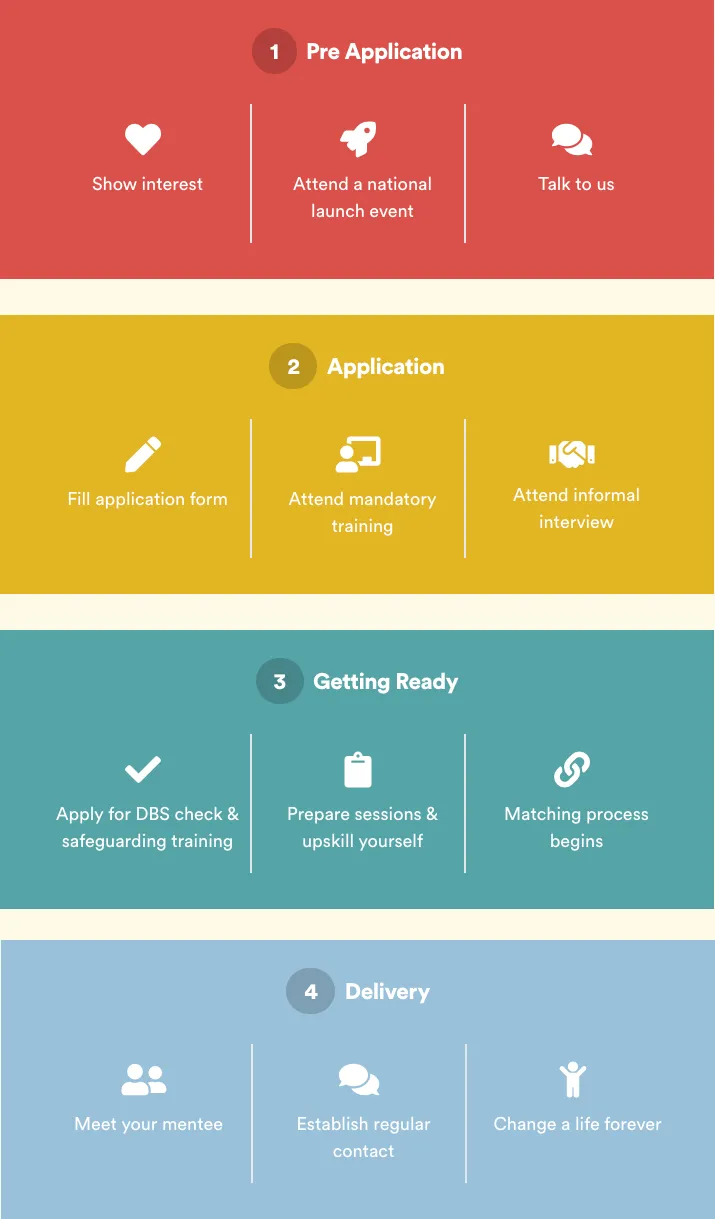
A UK-based organisation, runs a mentoring programme focused on building relationships between approved individuals and refugee children. It aims to give children a better start by providing direct mentoring support. Its mentoring process is documented in the following visual:
Defence for Children International Italia: RoAD to adulthood mentorship programme
For migrant and refugee unaccompanied children is implemented in Italy as part of a wider European initiative.
IRC with ICEI: "Mentors make the difference" – Mentors for integration
Is a one-to-one mentoring programme in Italy that aims to connect young asylum seekers, refugees, and migrants with volunteer mentors from the local community. The project focuses on helping young migrants to develop skills and build a network of relationships to orientate themselves in the labour market.
Set up in 2016 in the UK, the Mentoring Programme trains volunteer mentors to provide weekly one-to-one support and advice to young refugees and asylum seekers in line with their goals and aspirations.
Mentoring: Useful tools and resources
Click to open in new tab.

Meet: A compendium to design migrant mentoring programs
CESVI. Guidelines on designing and setting up a mentoring programme – including for example, selection, recruitment, training etc.
Click here to open
Mentoring migrant children and youth, regardless of residence status
University of Gerona (2021) Guidance.
Click here to open

Mentoring methodological framework for MINT project
Child to Child/MINT Project (2021). A resource for mentoring migrant children that includes guidance and tools for mentoring in practice.